Raufarhólshellir Lava TunnelAn Independent Guide Check Availability

Raufarhólshellir Lava Tunnel Tour: One Hour Under the Þrengsli Road

Lava drained out of this tube 5,200 years ago and left a corridor 30 meters wide beneath the Þrengsli road, lit and bridged along the first stretch. Pick the Raufarhólshellir lava tunnel tour that suits how you are travelling, and book with free cancellation.

Updated July 2026

  • From $67.07
  • Runs every day of the year
  • Free cancellation 24h

Quick answer

Every Raufarhólshellir lava tunnel tour walks the same lit footbridge for about 55 to 60 minutes, so the price you pay decides how you get there, not what you see. Meeting at the cave costs $67.07 to $70.48. Riding out from Reykjavík costs $151.19 by bus. One tour goes further: the Lava Falls Adventure carries on past the lighting to the far end of the tube for $219.39.

Key takeaways

  • Most booked: the operator's own Underground Expedition at $70.48, rated 4.7 from 1,942 reviews, one hour, meet at the cave
  • Cheapest: the Arctic Adventures tour at $67.07, rated 4.7 from 842 reviews, with a Reykjavík pickup option on the same ticket
  • No car: the ICELANDIA bus from the BSÍ terminal, $151.19 for three hours door to door, Wi-Fi on board, 4.6 from 848 reviews
  • Want more than an hour: the Lava Falls Adventure, $219.39, three hours, head torches past the end of the walkway, 4.9 from 41 reviews
  • Included on all of them: helmet, headlamp and crampons in winter. You bring a waterproof jacket and hiking shoes
  • All four hold free cancellation up to 24 hours before departure, and all four run year-round, including January
Free cancellation 24h
Reserve now, pay later
Helmet and headlamp included
Guided access, every departure
1,360 meters Length of the lava tube
5,200 years Since the Leitahraun eruption drained it
30 minutes From Reykjavík by road
3 to 4°C Inside the cave, every month

Check Dates at the Cave

Live availability for the $70.48 Underground Expedition, the tour that meets at the cave entrance. Departures run on the hour and the middle of the day fills first in July and August, when tour buses from Reykjavík land between 10:00 and 14:00.

Powered by GetYourGuide

The Three Standard Tours

These three put you on the same footbridge for the same hour with the same operator, and the gap between them is transport. Read the meeting point before you read the price: two start at the cave, one starts at a bus terminal in Reykjavík. The fourth tour, which goes past the lighting, sits further down this page.

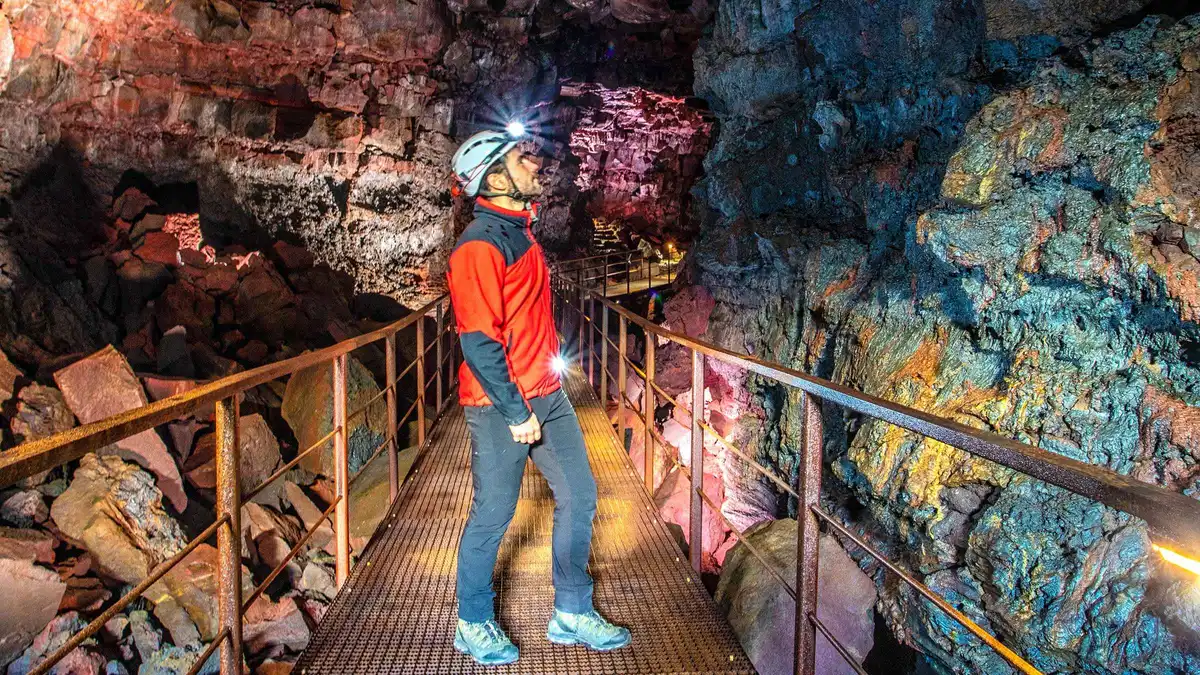
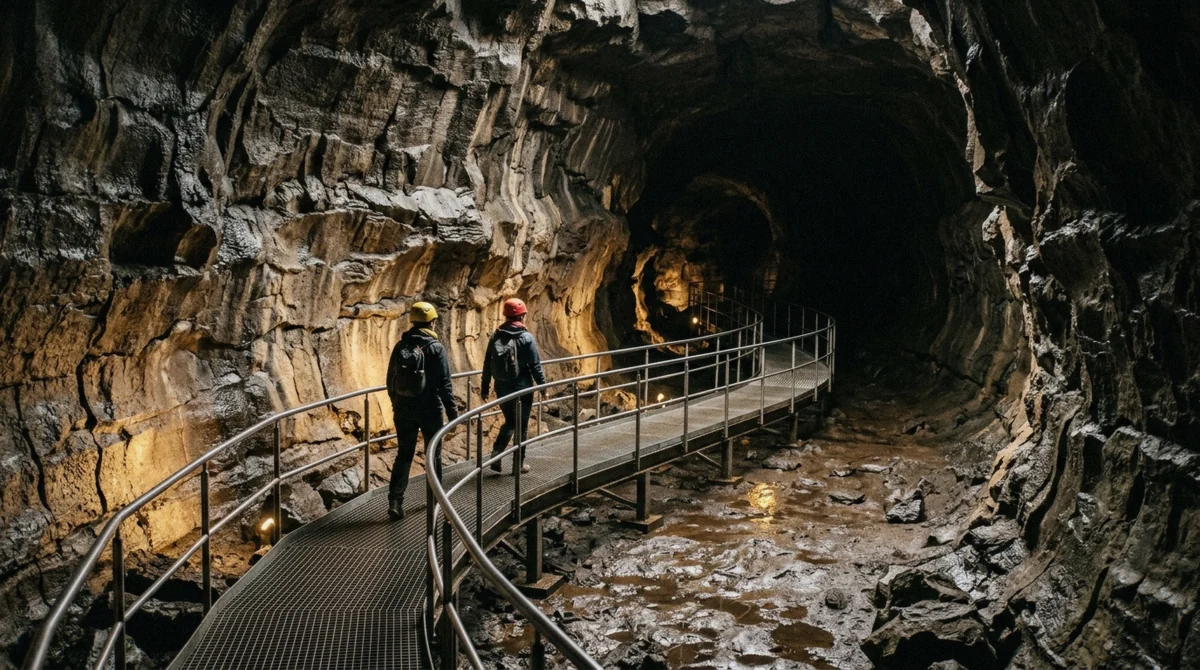
Visitors on the lit footbridge inside the cave on the Underground Expedition Raufarhólshellir lava tunnel tour, Þrengsli, Iceland from $70.48

Raufarhólshellir Lava Tunnel: Underground Expedition

★★★★★ ★★★★★ 4.7(1,942 reviews)· 1 hour
Check Availability
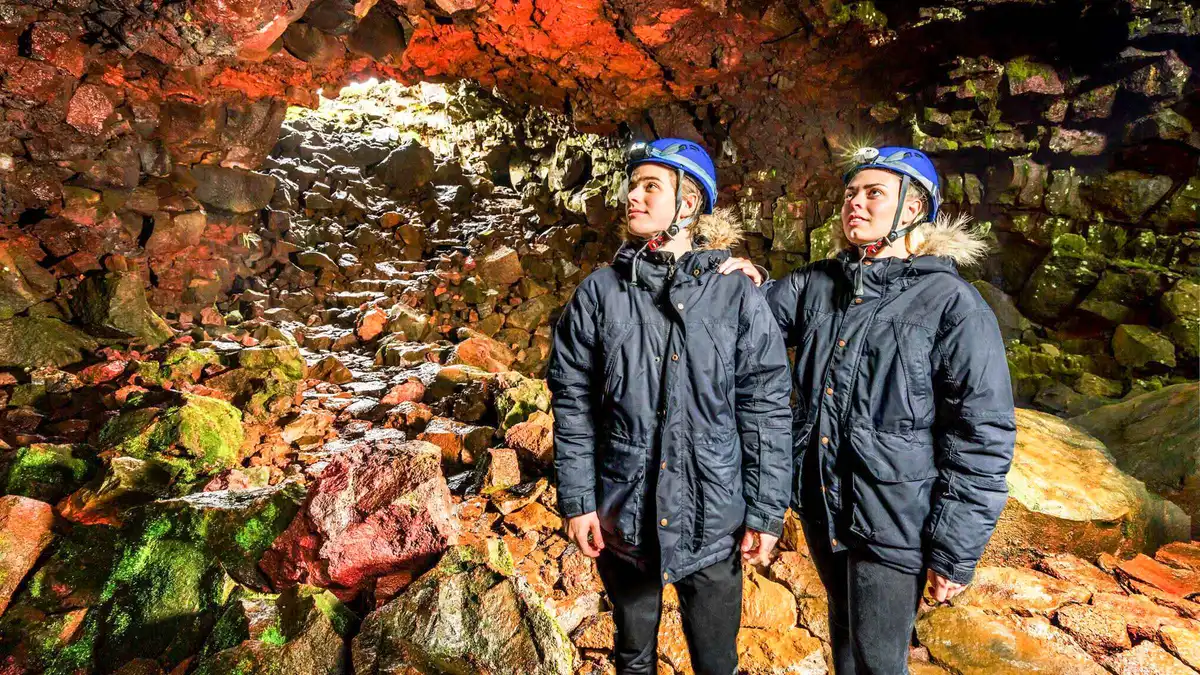
Guided group in helmets walking the lava tube on the Arctic Adventures Raufarhólshellir lava tunnel tour from Reykjavík, Iceland from $67.07

From Reykjavik: Raufarhólshellir Lava Tunnel Tour

★★★★★ ★★★★★ 4.7(842 reviews)· 1 - 3 hours
Check Availability
Coach passengers entering the cave mouth on the ICELANDIA bus Raufarhólshellir lava tunnel tour from Reykjavík, Iceland from $151.19

From Reykjavik: Raufarhólshellir Lava Tunnel by Bus

★★★★★ ★★★★★ 4.6(848 reviews)· 3 hours
Check Availability

Departures run hourly from 9:00 to 17:00, and the summer middle of the day books out first.

Free cancellation up to 24 hours before departure

Check Availability

We earn a commission if you book through these links. The price you pay is the same.

Three Ways to Reach the Cave, One Hour Underground

The cave charges for an hour on the footbridge. Everything above that hour is the road. Driving yourself to the entrance and taking the operator's own tour costs $70.48; the ICELANDIA bus from the BSÍ terminal costs $151.19 for the same guided hour, a difference of about $81 per person. If two of you have a rental car parked outside the guesthouse, that gap is $162 to sit on a bus.

Option Price Total time Book Inside the cave Best for
Underground Expedition $70.48 1 hour Check 55 to 60 min Driving yourself
Arctic Adventures tour $67.07 1 or 3 hours Check 1 hour Cheapest, works either way
ICELANDIA bus $151.19 3 hours Check 1 hour No car, hotel pickup
Lava Falls Adventure $219.39 3 hours Check To the lava falls An hour sounds short

The Tube You Walk Into

Raufarhólshellir is the fourth-longest lava tube in Iceland and the only one of the big four you can reach in a 30-minute drive from the capital. The numbers below are what the guide will point at while you stand under them, and they explain why this cave took a footbridge and floodlights while others take a rope.

The lit steel footbridge running through the Raufarhólshellir lava tunnel on a guided Raufarhólshellir lava tunnel tour in southwest Iceland
1,360 meters Total length of the tube Fourth-longest in Iceland. Víðgelmir in the west beats it at 1,585 meters, and Surtshellir runs close to 1,600 meters, but both sit hours from Reykjavík
900 meters The main tunnel, before it splits At its end the passage divides into three smaller tunnels, and the lava falls that gave the adventure tour its name sit in that final section
30 meters wide At the widest point This is why nobody feels shut in. Reviewers who describe themselves as claustrophobic say the same thing: the corridor is wider than a house
10 meters Headroom under the roof Where Route 39 crosses overhead the tube narrows to roughly 15 meters across, with cars passing above without a sound reaching you
5,200 years Since the lava stopped flowing The Leitahraun eruption fed it from a vent 10 kilometers uphill. Carbon dating in the scientific record puts the flow closer to 5,600 years old
3 to 4°C Air temperature, all year The rock holds the same temperature in July as in January, and water drips through the roof in every season, which is why a waterproof jacket beats a warm one

What Raufarhólshellir Actually Is

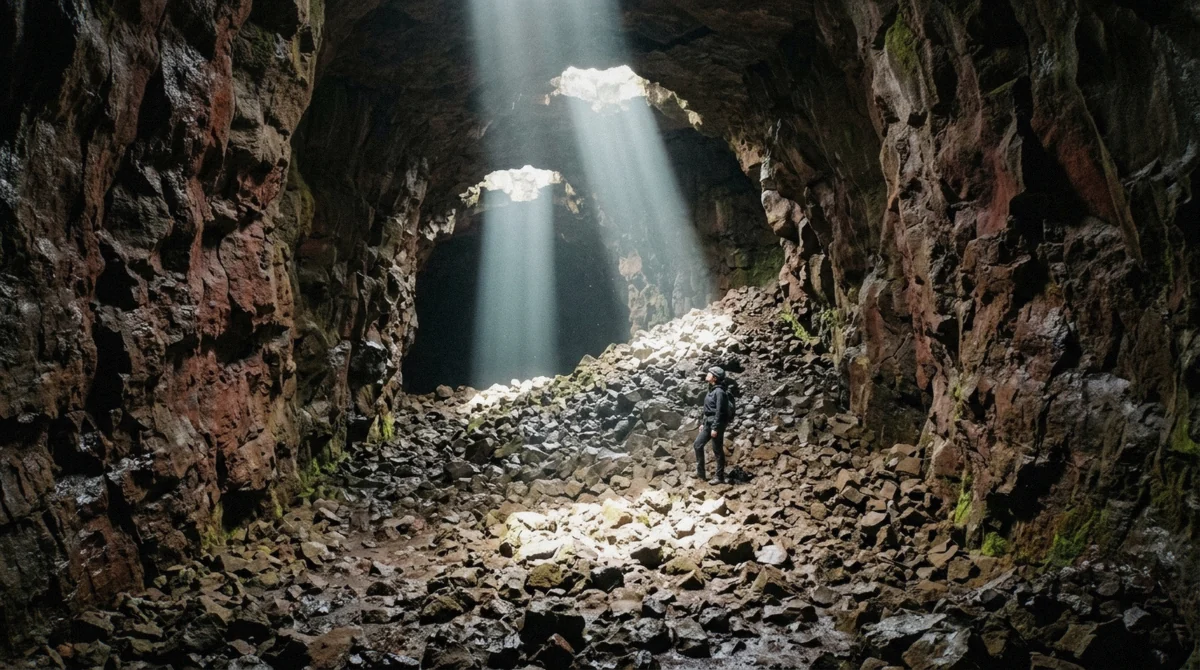
Columns of daylight falling through collapsed skylights near the entrance of Raufarhólshellir on a Raufarhólshellir lava tunnel tour, Þrengsli, Iceland

A river of lava left the building

A lava tube is a drainpipe that outlived its water. When the Leitahraun eruption sent low-viscosity lava down this slope 5,200 years ago, the surface of the flow cooled into a crust while the molten rock underneath kept running. The crust thickened into a roof. Once the eruption stopped, the lava inside drained downhill and out, and the roof stayed up over an empty corridor 1,360 meters long.

The vent that fed it sits 10 kilometers uphill, east of the Bláfjöll mountains. Everything you walk past inside was liquid at the same moment: the ledges along the walls mark where the lava level paused on its way down, and the ripples underfoot froze mid-flow. Nothing here was carved. It was drained.

Three columns of daylight at the entrance

Near the mouth the roof has collapsed in three places, and each hole drops a column of light onto the floor. On a clear winter afternoon the light lands blue on old ice. Photographers work this section hardest, and it is the one part of the tour where you get daylight and cave in the same frame.

Past the skylights the roof closes over and the floodlighting takes over. The walkway lights are set low and warm rather than white, which is a deliberate choice: they show the rock without flattening it.

Red, green and purple on the walls

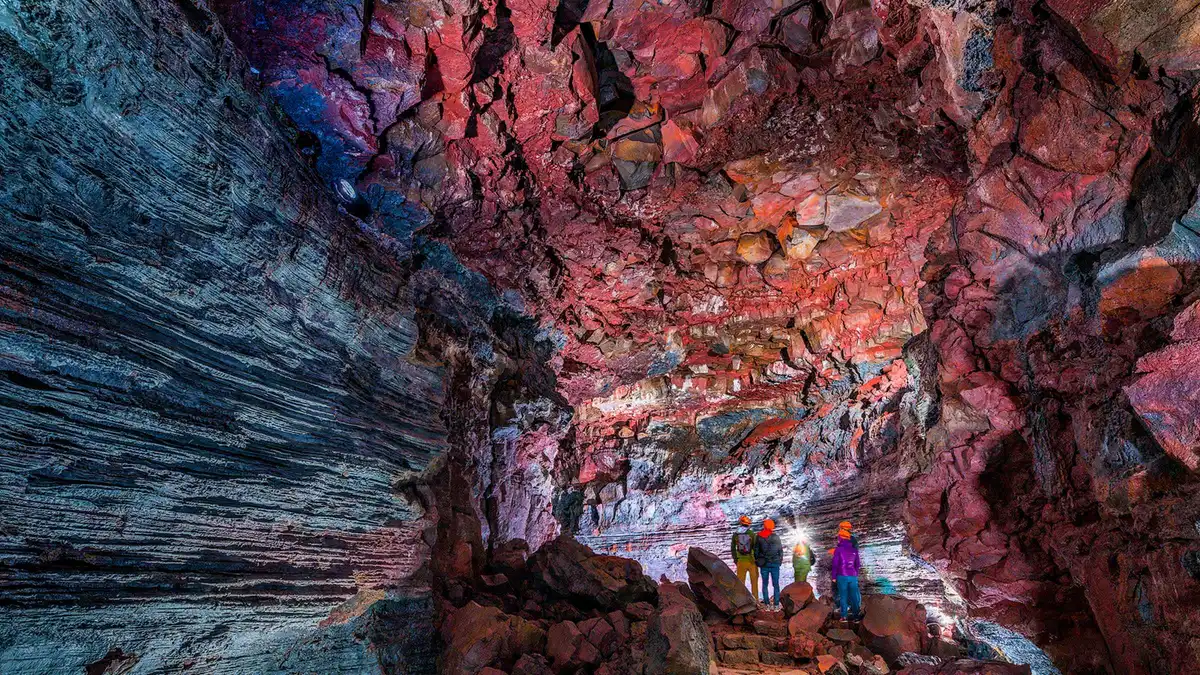
The colour comes from minerals in the rock reacting with air and water over five thousand years. Iron gives the deep rust and red, and copper and other traces account for the greens and the purple-grey. Guides turn the walkway lights off at one point so the group stands in absolute darkness, which sounds like a gimmick until it happens and you understand that there is no such thing as your eyes adjusting down here.

The cave used to hold far more than colour. Lava stalactites hung across whole stretches of the roof until visitor numbers grew from the 1950s onward, and the fragile lava straws were snapped off one by one by people who wanted a souvenir. Almost none survive.

The cave that had to be closed

By 2015 more than 20,000 people a year were walking into Raufarhólshellir unsupervised, with head torches, spray paint and no rules. The owners closed it in late 2016. Crews hauled out several metric tons of rubbish, then built the elevated walkway, ran power in for the lighting, and reopened in mid-2017 with access by guide only.

That history is why you cannot park at the entrance and wander in today. It is also why the floor is intact. The trade the operator made was infrastructure and a gate in exchange for the cave surviving another century, and standing on the bridge you can see both halves of that bargain at once.

Hollywood found it first

The tube was a filming location for the 2014 film Noah with Anthony Hopkins, and it turns up in the Netflix series Sense8. In June 2017 the Secret Solstice festival ran concerts inside it, using the natural acoustics of a 30-meter-wide basalt corridor.

Guides tell these stories on the walkway, and the tour leans on them. If you came for geology rather than film trivia, the Lava Falls Adventure is the version that spends its time on the rock.

How the Tunnel Emptied Itself

Four stages separate a moving lava flow from the corridor you walk through. The section you visit on a standard tour is the lit front third; the dark two thirds beyond it belong to the adventure tour.

Route 39 1 2 3 4
  • Lit section Footbridge and floodlights, 55 to 60 minutes, every standard tour
  • Dark section Head torches, loose rock, no walkway, Lava Falls Adventure only
  • Lava falls Where the tube splits into three branches at the far end
  1. 1

    The flow crusts over

    Lava from the Leitahraun eruption runs downhill from a vent 10 kilometers away. Air chills the surface into a hard crust while the rock underneath stays molten and keeps moving.

  2. 2

    The crust becomes a roof

    The skin thickens until it can hold its own weight. Insulated from the air, the lava underneath runs hotter and faster inside its own pipe, cutting the channel wider and deeper.

  3. 3

    The lava drains out

    The eruption stops feeding the tube. What is left inside runs downhill and out, leaving a void up to 30 meters wide and 10 meters high, with ledges on the walls marking each pause in the level.

  4. 4

    The roof gives way in places

    Sections of the ceiling collapse over the following centuries. Three of those holes near the entrance became the skylights, and the rubble piles under them are what you climb past on the first minutes of the walk.

Cross-section is schematic. Depth below the surface varies along the tube, and Route 39 crosses over the widest part of it.

Getting There and What to Wear

The drive is 35 km and takes half an hour

From Reykjavík it is a 30-minute drive: Route 1 east for about 18 km, then south onto Route 39, the Þrengsli road, for another 12 km. The reception building and car park sit on the left. Route 39 is paved, gritted through winter and open to a two-wheel-drive rental, and it doubles as the low-altitude alternative when Hellisheiði closes in a storm.

Hveragerði lies 15 km east of the turn-off, which puts the cave on the way to the south coast, Kerið and the Golden Circle. Most people fit it either side of a Selfoss lunch.

You cannot go in without a guide

Access is by guide only, and has been since the 2017 reopening. The gate at the entrance stays locked between departures, so a walk-up without a booking is a wasted drive in high season. Departures run on the hour from 9:00 to 17:00, and the site is open every day of the year, including Christmas week.

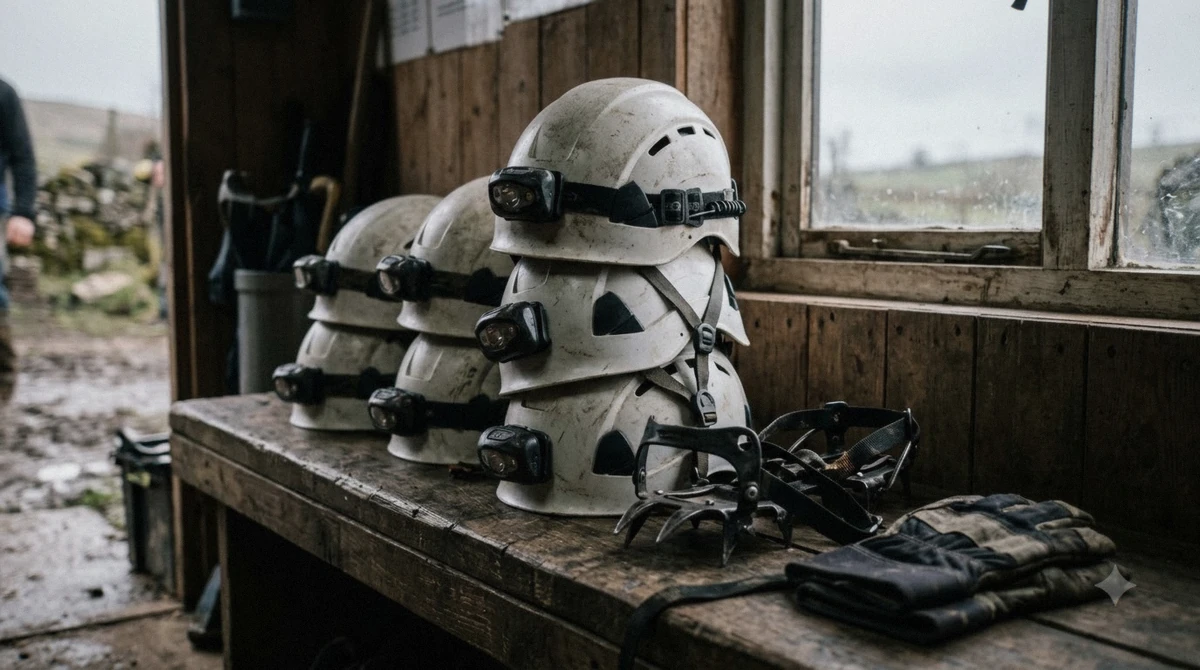
Groups gather at the reception building, where the guide hands out a helmet and a headlamp, and crampons through the winter months. Coffee and toilets are there too, which matters more than it sounds on the way back from the south coast.

Helmets and headlamps laid out at the reception before a Raufarhólshellir lava tunnel tour at the cave entrance in Þrengsli, Iceland

Waterproof beats warm

The cave holds 3 to 4°C in every month, so nobody freezes on a one-hour walk. Water is the problem. Meltwater and rain work through the rock and drip from the roof all year, and the drips land on your shoulders and your camera.

What to bring:

  • A waterproof jacket with a hood. This is the one item people regret leaving in the car
  • Warm mid layer, wool or fleece. Jeans are fine for the standard tour and a poor idea on the adventure tour
  • Hiking shoes with grip. The walkway is steel mesh, the ramps in and out are wet rock
  • Gloves and a hat between October and April, when the entrance ices over
  • A camera that copes with low light. Phones manage the skylights and struggle deeper in

Who should skip it

The route in and out crosses uneven ground and a steep set of steps before the footbridge starts, and parts of the floor are left as the lava made them. Operators say the tour does not suit anyone who has trouble with balance, rough surfaces or stairs. There is no wheelchair access.

Minimum age is 3 years when you meet at the cave and 6 years on the Arctic Adventures pickup, since that ticket includes a bus. The Lava Falls Adventure is 12 and over, and it asks for decent fitness: three to four hours, no walkway underfoot for most of it, and scrambling over collapsed roof material.

What the seasons change

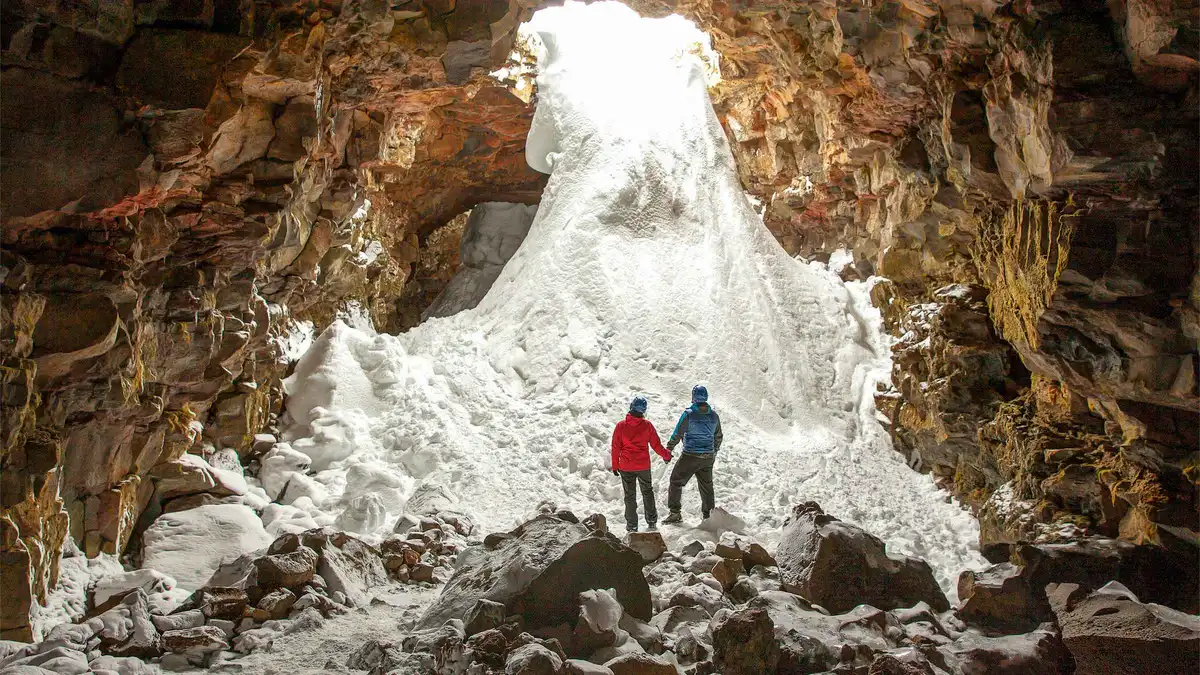
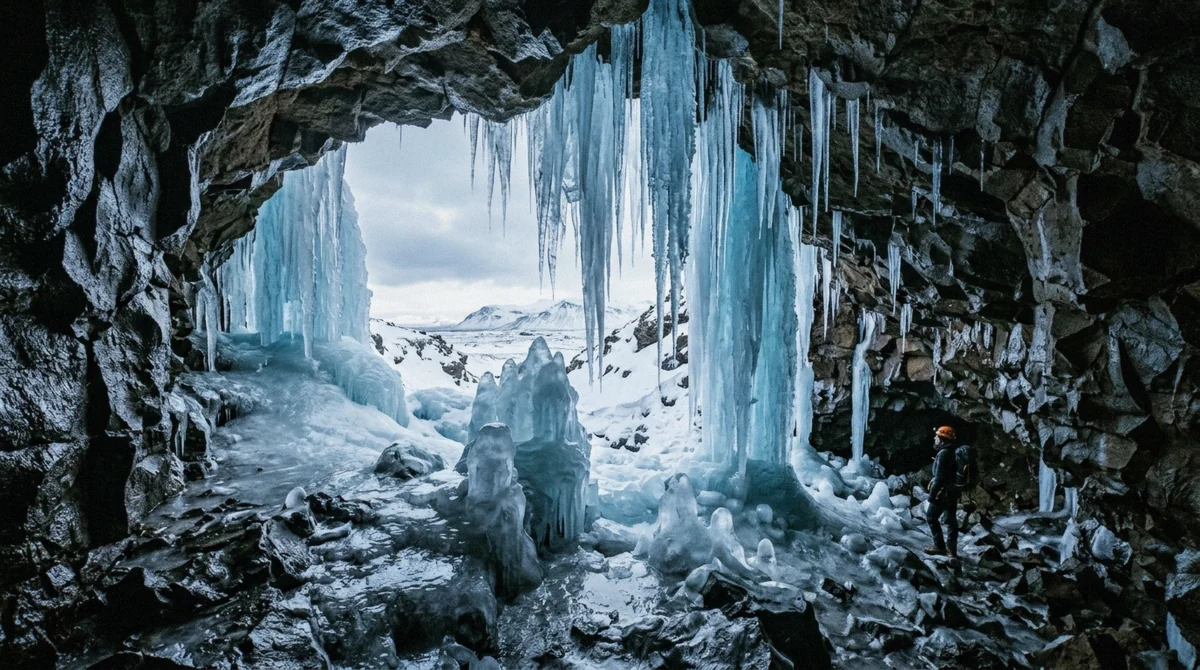
The rock does not change. The entrance does. Ice sculptures grow inside the mouth of the cave from late autumn, reach their best in December, January and February, and melt back through spring. Crampons come out over the same months and are handed to you at reception.

Daylight is the other variable. In December you drive both ways in the dark, which makes an 11:00 departure the sensible pick; in June the road is lit until midnight and a 17:00 tour leaves the whole evening free.

MonthsInside the caveGetting thereCrowds
December to FebruaryIce sculptures at their biggest, crampons issuedDark both ways, Route 39 grittedQuietest, book a day ahead
March to MayIce retreating, meltwater dripping hardLight returns fast, roads clearBuilding through May
June to AugustNo ice, driest floor of the yearDaylight until midnightBusiest, midday departures sell out
September to NovemberFirst ice forms near the mouthStorms can close Hellisheiði, not Route 39Quiet again after September

What it costs booked direct

The operator sells the same standard tour on its own site for 8,900 ISK, and its bus package from Reykjavík for 14,900 ISK. At 125 ISK to the dollar in July 2026 that is about $71 and $119. The Lava Falls tour lists at 27,900 ISK.

So the on-location tours cost roughly the same wherever you book, and the difference sits in the transport packages. Booking through a platform buys you free cancellation up to 24 hours before departure and payment in your own currency, which is worth something on a trip where weather rearranges plans.

Where Raufarhólshellir Is

The cave sits off Route 39 in Þrengsli, 35 km southeast of Reykjavík and 15 km west of Hveragerði. Type Raufarhólshellir into a satnav and it lands you at the reception car park.

Coordinates N63°56.407 W021°23.742. Parking is free and sits on the left as you come south on Route 39.

Which Cave in Iceland to Book

People compare four underground trips in Iceland, and only two of them are lava tubes you can drive to in a morning from Reykjavík. This is what separates them.

  • closest

    Raufarhólshellir

    Where
    Þrengsli, 35 km from Reykjavík
    Age
    5,200 years, Leitahraun
    Getting in
    Walk in, lit footbridge

    1,360 meters long and the fourth-longest in Iceland. Wide, tall and floodlit for the first stretch, with skylights at the entrance and ice sculptures in winter. The only one of these four that runs every day of the year, and the cheapest to reach.

  • Víðgelmir

    Where
    Borgarfjörður, 190 km from Reykjavík
    Age
    About 1,100 years, Hallmundarhraun
    Getting in
    Staircase, wooden walkway

    Longer at 1,585 meters and the biggest by volume in Iceland, with lava stalactites still in place because it was gated early. It is a 1.5-hour drive each way from the capital, so it eats a day rather than a morning.

  • Vatnshellir

    Where
    Snæfellsnes, 190 km from Reykjavík
    Age
    About 8,000 years
    Getting in
    Spiral staircase, 35 meters down

    Small and vertical: 200 meters of passage on two levels inside Snæfellsjökull National Park, visited on a 45-minute tour. Worth pairing with the peninsula rather than driving out for on its own.

  • not a tube

    Þríhnúkagígur

    Where
    Bláfjöll, 30 km from Reykjavík
    Age
    About 4,000 years
    Getting in
    Open lift, 120 meters down

    A drained magma chamber rather than a lava tube, entered by a window-cleaner's lift that lowers you 120 meters into the void. It runs from about May to October and costs several times what any cave here does.

Distances are one-way road distances from Reykjavík. Þríhnúkagígur closes for winter; the three lava caves stay open.

What People Wrote After Going

★★★★★ ★★★★★
Nice easy trip down the tunnel. Plenty of space in the tunnel 15+ feet wide and high in most areas and even for my claustrophobic wife it was not an issue. The guide was very helpful in explaining the whole episode that created the tunnel.
Guy · Canada · July 2026
★★★★★ ★★★★★
This was a fun quick activity that taught us a little bit about lava flow and tunnels it left behind. It was a beautiful little hike in our guide was very informative.
Tonia · United States · June 2026
★★★★★ ★★★★★
Dmitri, the guide at the tunnel, was fantastic. Very informative and great sense of humour. It was informative and fun
Claire · United Kingdom · June 2026

Quotes come from the GetYourGuide listings for the tours on this page, reproduced as written.

Ice sculptures inside the entrance of Raufarhólshellir in January, seen on a winter Raufarhólshellir lava tunnel tour in southwest Iceland
Winter ice builds where daylight and cold air reach through the collapsed roof. It peaks in December, January and February, and it is gone by early summer.

Reading These Four Tours Before You Book

The hour inside is fixed

Standard tours all buy the same 55 to 60 minutes on the same footbridge with the same operator. Price differences are transport and pickup, so start from how you are getting there rather than from the cheapest number.

$81 is the bus fare

The gap between meeting at the cave for $70.48 and riding out for $151.19 is about $81 a head. With a rental car outside your guesthouse and a 30-minute drive, that is the easiest money to keep on an Iceland trip.

An hour is short, and reviewers say so

The recurring complaint on all three standard listings is that the time inside feels short, especially on the bus tour where an hour underground sits inside a three-hour round trip. Know it before you book, not after.

The adventure tour is the honest fix

The Lava Falls Adventure runs three to four hours, drops the walkway, hands out head torches and goes to the end of the tube where the lava falls are. It is 12 and over, needs fitness, and holds 4.9 from 41 reviews.

Winter is the better cave

Ice sculptures at the entrance from December through February, crampons at the door and quieter departures. Summer gives you dry floors, long light and midday slots that sell out first.

Book by the hour, not the day

Departures run on the hour from 9:00 to 17:00. In December an 11:00 slot keeps the drive in daylight; in June a 17:00 slot leaves the whole evening free. Free cancellation runs to 24 hours before.

Questions People Ask Before Booking

Is the lava tunnel tour worth it?

For $70.48 and an hour of your day, yes, with one caveat that shows up in review after review: the time inside feels short. What you get is a floodlit walk through a 1,360-meter lava tube that is 30 meters wide in places, three collapsed skylights dropping daylight onto the floor, mineral colour on the walls and a lights-out moment in total darkness. What you do not get is a half-day. If an hour sounds thin, the Lava Falls Adventure at $219.39 spends three to four hours underground and reaches the far end. The tour that disappoints people most often is the $151.19 bus, where the same hour sits inside a three-hour round trip.

How long is the Raufarhólshellir lava tunnel?

The tube runs 1,360 meters, which makes it the fourth-longest lava tube in Iceland. The main tunnel accounts for about 900 meters of that before splitting into three smaller branches at the far end. Standard tours cover the front section on a lit footbridge in 55 to 60 minutes; the rest, including the lava falls in the branches, is reached only on the Lava Falls Adventure with head torches.

Which lava tunnel is best in Iceland?

For a morning out of Reykjavík, Raufarhólshellir: 35 km from the city, open every day of the year, with a footbridge that suits children from age 3. For the longest and best-preserved cave, Víðgelmir in Borgarfjörður runs 1,585 meters and still has its lava stalactites, but it is a 1.5-hour drive each way. Vatnshellir on Snæfellsnes is the smallest of the three at 200 meters, entered by a spiral staircase 35 meters down, and it makes sense as part of a peninsula day rather than a trip in itself.

What is the best volcano tour in Iceland?

It depends on what you want to stand inside. Raufarhólshellir puts you in a lava tube left by an eruption 5,200 years ago, runs year-round and costs $67.07 to $219.39. Þríhnúkagígur lowers you 120 meters into a drained magma chamber by lift, but only from about May to October and at several times the price. Eruption-site hikes on the Reykjanes peninsula depend entirely on whether anything is erupting and on the day's gas readings. Of the three, the lava tunnel is the one that runs in January and does not get cancelled by weather.

Can you visit Raufarhólshellir without a tour?

No. Access is by guide only. The cave was open to anyone until late 2016, when more than 20,000 unsupervised visitors a year and several metric tons of rubbish forced the owners to close it. It reopened in mid-2017 with an elevated walkway, lighting and a gate. Every visit now goes through a booked departure from the reception building at the entrance.

How much does the Raufarhólshellir lava tunnel tour cost?

Meeting at the cave costs $67.07 with Arctic Adventures or $70.48 with the operator's own Underground Expedition. The ICELANDIA bus from the BSÍ terminal in Reykjavík is $151.19 including transport both ways. The Lava Falls Adventure is $219.39. Booked direct on the operator's site the standard tour lists at 8,900 ISK and the bus package at 14,900 ISK, about $71 and $119 at 125 ISK to the dollar in July 2026.

How do you get to the lava tunnel from Reykjavík?

Drive Route 1 east for 18 km, then turn south onto Route 39, the Þrengsli road, and continue 12 km to the car park on the left. The whole trip is 35 km and takes about 30 minutes on a paved road that stays open through winter. Without a car, the ICELANDIA tour leaves the BSÍ terminal and offers hotel pickup, and the Arctic Adventures ticket has a pickup option with 24 drop-off points across the city.

What should I wear inside the lava tunnel?

A waterproof jacket first: the roof drips in every season and the cave holds 3 to 4°C all year. Add a warm mid layer, hiking shoes with grip for the wet rock at the entrance, and gloves and a hat between October and April. The helmet, headlamp and winter crampons come with every tour. Leave anything you cannot get wet in the car.

Is the tour suitable for children and older visitors?

Minimum age is 3 when you meet at the cave and 6 on the Arctic Adventures pickup option, since that one includes a bus. The Lava Falls Adventure is 12 and over. The footbridge covers most of the route, but the way in and out crosses uneven ground and a steep flight of steps, so operators advise against it for anyone with balance problems or difficulty on stairs. There is no wheelchair access.

When is the best time of year to visit the lava tunnel?

December through February for ice: sculptures grow inside the entrance where cold air and daylight reach through the collapsed roof, and they are at their biggest in those three months. June through August for daylight and dry floors, with midday departures selling out first. The cave itself sits at 3 to 4°C whatever the calendar says, and departures run every day of the year from 9:00 to 17:00.

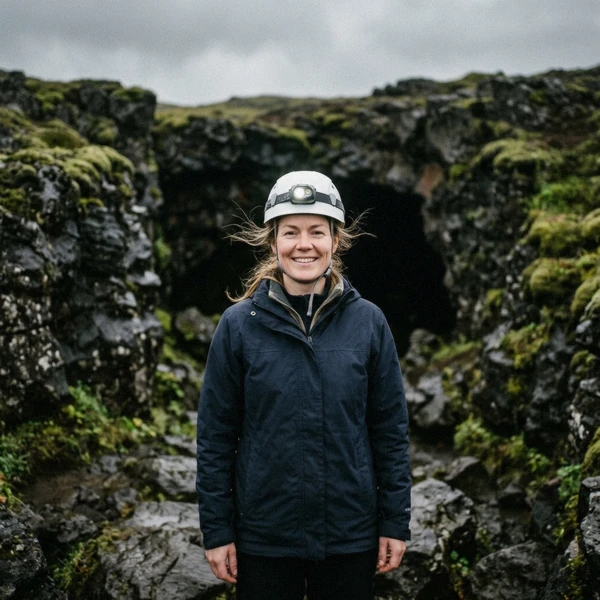
Hrafnhildur Ýr Jónsdóttir, caving guide, in a helmet at the entrance to the Raufarhólshellir lava tunnel in Þrengsli, Iceland

Your guide

Hrafnhildur Ýr Jónsdóttir

Caving guide, Þrengsli · guiding groups through Raufarhólshellir since 2018

Eight winters of handing out helmets at the gate on Route 39 and walking groups over the footbridge. Writes this site between departures, checks every operator's small print, and will tell you when the bus ticket is the wrong one to buy.

One tube, four ways in, and free cancellation on all of them. Check which departures are open for your dates.

Hourly departures, 9:00 to 17:00, every day of the year

Check Availability

Bookings are handled by the operator or platform. We may earn a commission at no extra cost to you.

Tours from $67.07 Check Availability