Best Time of Year for the Raufarhólshellir Lava Tunnel Tour

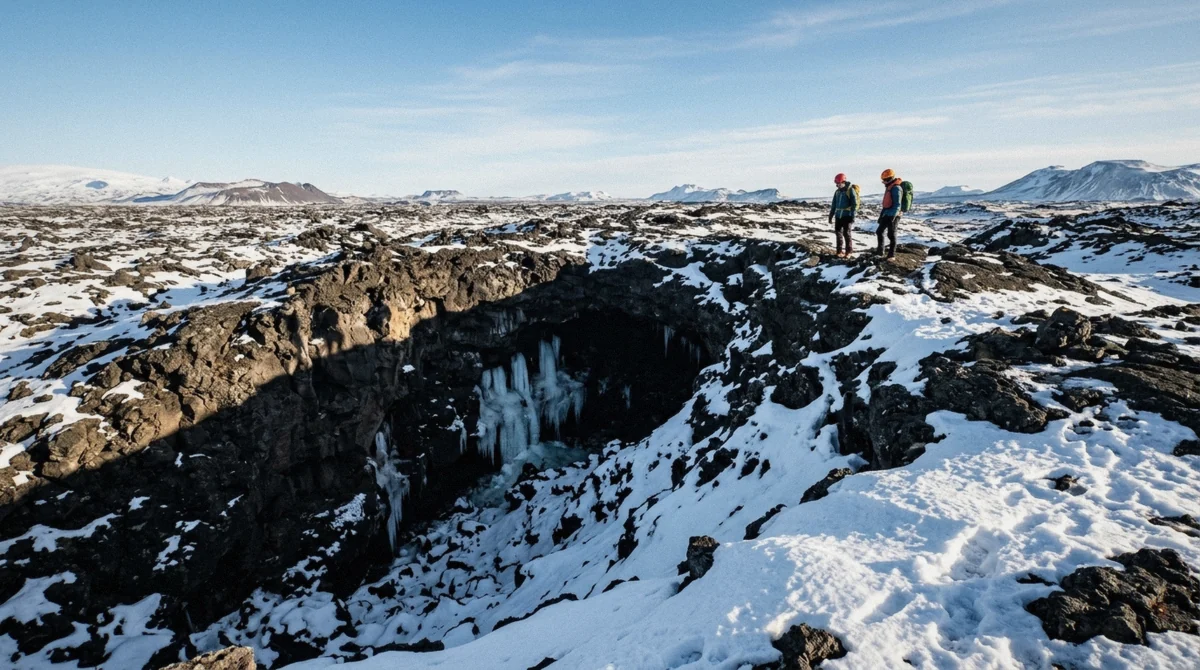
The best time to visit the Raufarhólshellir lava tunnel is December through February, when ice sculptures fill the entrance and crowds thin out to their lowest point of the year. June through August is the strong runner-up, trading the ice for long daylight and dry footing, at the cost of the busiest midday departures. The one stretch to plan around is late spring, March into May, when meltwater is heaviest and the entrance is at its wettest. Underground the cave itself never changes: 3 to 4°C and open every day of the year, including Christmas week.
Quick answer
December through February is the best window for the Raufarhólshellir lava tunnel, driven by ice sculptures at the entrance and the year's smallest crowds. June through August runs a close second on daylight and dry conditions, but midday departures sell out first. The cave's own temperature, 3 to 4°C, never moves, so the calendar only changes the entrance, the drive, and who else is booked on your departure.
Key takeaways
- Best window: December to February, for ice sculptures at the entrance and the quietest departures
- Runner-up: June to August, for long daylight and a dry floor, trading away the ice and the quiet
- Month to plan around: March to May, when meltwater from the thaw drips hardest through the roof
- Counterintuitive fact: the cave's temperature never changes season to season, only the entrance and the drive do
- Best time of day: any hour works, but a 9:00 or 10:00 departure beats the midday rush from June to August
- Price and crowd signal: prices hold flat year-round, but July and August midday slots book out days ahead
Seasons at a Glance
Read the Verdict column first: it is the one-line call for that month, built from ice, daylight, and how full the car park gets.
Month by month
Dates and prices for every Raufarhólshellir lava tunnel tour and its dates and prices sit on the homepage if you are still choosing a ticket.
| Month | Conditions | Weather | Crowds | Verdict |
|---|---|---|---|---|
| January | Ice sculptures building, crampons issued | Cold, dark drive, gritted road | Low | Best overall |
| February | Ice sculptures at their biggest | Cold, daylight returning fast | Low to moderate | Best overall |
| March | Ice retreating, drips increasing | Milder, roads clear | Moderate | Good, wetter floor |
| April | Little ice left, heavy meltwater | Mild, longer daylight | Moderate, building | Wettest month |
| May | No ice, heaviest drip season | Mild, long daylight | Building toward peak | Skip if you dislike wet |
| June | Dry floor, no ice | Warm, daylight past midnight | High | Good, plan around midday |
| July | Dry floor, no ice | Warmest month | Peak | Busy, book ahead |
| August | Dry floor, no ice | Warm, daylight shortening | Peak | Busy, book ahead |
| September | First ice forming near the mouth | Cooling, storms begin | Moderate, easing | Good value |
| October | Ice building at the entrance | Storms more frequent on Hellisheiði | Low to moderate | Good, quieter |
| November | Ice established | Cold, short daylight | Low | Good, quiet |
| December | Ice near its peak | Coldest, shortest daylight | Low, holiday week aside | Very good |
The table above uses typical patterns rather than a single fixed date for the ice or the meltwater, since both shift a few weeks either way depending on that winter's cold. What holds steady across every month is the road: Route 39 stays gritted and open through the coldest weeks, since it is the low-altitude alternative used when the higher Hellisheiði route closes in a storm.
Temperatures and rainfall on the drive out
| Month | Air on the drive | Rain |
|---|---|---|
| January | Cold, often below freezing | High |
| February | Cold | Moderate |
| March | Cool, thaw beginning | Moderate |
| April | Cool to mild | Moderate |
| May | Mild | Moderate |
| June | Mild to warm | Low to moderate |
| July | Warmest of the year | Moderate |
| August | Warm | Moderate |
| September | Cooling | Moderate |
| October | Cool, storms more frequent | High |
| November | Cold | High |
| December | Cold, shortest daylight | High |
These are typical conditions for the drive out to Þrengsli, above ground, not inside the cave, which holds a steady 3 to 4°C regardless of the weather that day. July and August run warmest, and December and January run coldest with the heaviest rain. For exact figures on your travel dates rather than a seasonal pattern, check the current forecast from the Icelandic Meteorological Office close to your trip.
Best Season by Traveler Type
If you want photographs of the entrance skylights
come in January or February, when low winter sun angles light through the collapsed roof onto ice below
If you are travelling with young children
aim for June to August, when the entrance floor is dry and there is no ice to navigate on the way in
If this is your first trip to Iceland and you want the safest bet
book September or October, before winter storms complicate the Ring Road but after the summer crowds have thinned
If you want the ice sculptures at their most dramatic
go in December or January, when the cold has had the longest run to build them up before any midwinter thaw
If you are travelling on a tighter budget and want short queues
pick a weekday morning in November, since tour prices do not move by season but the quietest departures cost nothing extra
Winter (December to February): Ice and the Quietest Departures
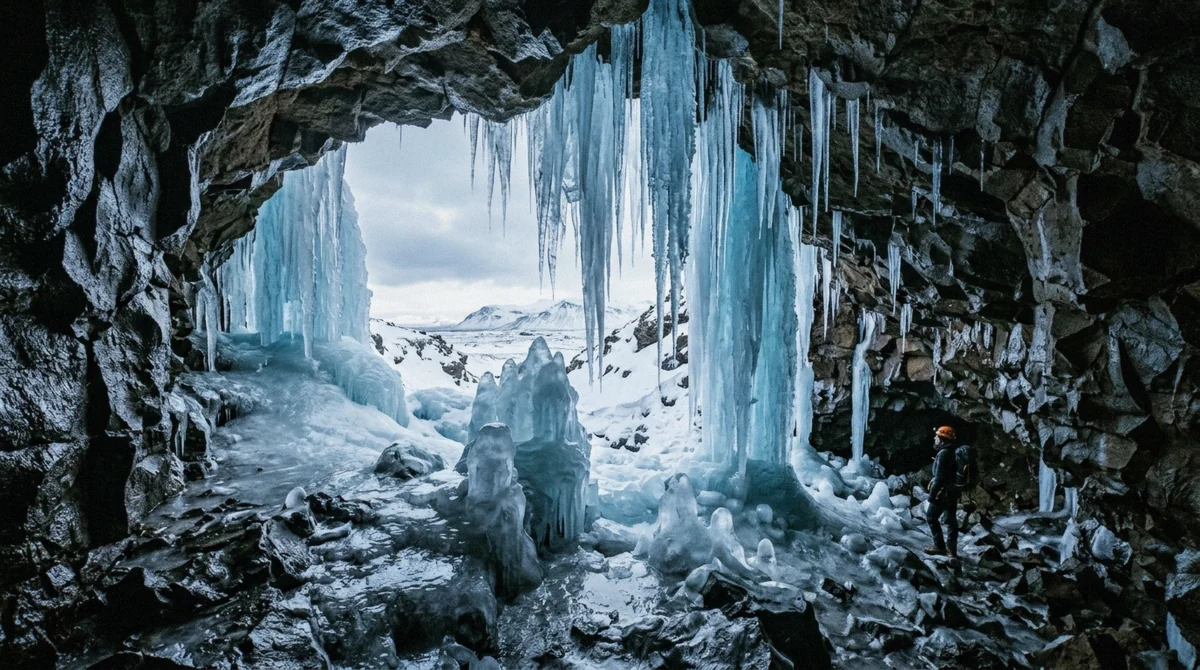
Winter is when the cave earns its reputation as more than a hole in the ground. Ice sculptures form inside the entrance from late autumn and reach their biggest in December, January and February, catching the low daylight that falls through the three collapsed skylights near the mouth. Air on the drive is cold, often below freezing, and Route 39 stays gritted through it, so the road itself is rarely the obstacle people expect.
Crowds are the lowest of the year, and departures a day or two ahead are usually enough outside the Christmas week itself. The trade-off is daylight: around the solstice there are only a few hours of it, which pushes an early booking toward the middle of the day and means a dark drive at both ends. The Underground Expedition runs on the hour through winter exactly as it does in July, ice or no ice.
Spring (March to May): Meltwater, Not the Time to Skip
Spring is the wettest stretch, not the coldest. As the ice at the entrance retreats, meltwater works through the rock above the walkway and the drip from the roof is at its heaviest of the year, on top of the steady dripping that happens every month regardless. Air temperature climbs steadily from cool in March to mild by May, and daylight lengthens fast.
Crowds build steadily toward the summer peak but are still well short of it. Prices do not move for the season, so the honest reason to plan around late spring is comfort rather than cost: bring the waterproof layer seriously, since this is the one stretch where the drip is doing more than usual. The Lava Falls Adventure crosses more open rock than the standard walkway and feels the wet season the most.
Summer (June to August): Daylight and the Busiest Midday
Summer trades the ice for the driest floor of the year and daylight that barely ends, with light in the sky past midnight in June. This is the warmest stretch on the drive out, and the entrance and the ramps are as dry as the cave gets.
This is also peak season, and the middle of the day fills first: tour buses from Reykjavík commonly land between 10:00 and 14:00, and a departure booked for that window in July or August can sell out days ahead. A 9:00 or an evening slot toward 16:00 or 17:00 avoids most of it. Booking a week or two ahead is the safer call through July and August; a few days is usually enough in June.
Autumn (September to November): Quiet Again, Ice Returning
Autumn is the reset. Crowds ease off through September as the summer schedule ends, and the first ice starts forming near the mouth of the cave as the nights turn cold. Air cools steadily from September into November, and daylight shortens quickly after the equinox.
The one thing to watch is storm season on Hellisheiði, the higher route between Reykjavík and the south coast: when it closes, Route 39 is the low-altitude road that stays open, since it was built as that alternative in the first place. Autumn is also a strong pick for value: same prices as July, none of the queue. The Reykjavík bus tour keeps its Wi-Fi and thirty drop-off points running through the season regardless of weather on the mountain road.
What Actually Affects Conditions
Most people assume a lava tube is the same wherever and whenever you visit it, since it sits below the reach of weather. It mostly is, and that is the point: the cave's own air holds at 3 to 4°C in every month, so the season changes almost nothing about what you feel underground. What changes is the entrance.
The skylights near the mouth are open to the surface, so cold air sinks into that stretch through the winter and lets the ice sculptures build, while warmer air and meltwater in spring wash them out again. The mechanism is straightforward: ice needs sustained cold above the collapsed roof for weeks at a time, not a single frosty night, which is why the sculptures peak in December through February rather than at the first cold snap of autumn.
Best Time of Day
Morning has the edge, and only for one reason: it beats the coach traffic. Tour buses commonly reach the reception building between 10:00 and 14:00 through summer, so a 9:00 departure gets you the footbridge with the smallest group of the day, every season. Outside July and August the time of day barely matters, since crowds are thin enough that any hour of the nine daily departures feels similar.
The one exception either way is winter light: an 11:00 or 12:00 slot keeps both legs of the drive on the Route 39 stretch in daylight during December, when the sun is up for only a few hours around midday. The Underground Expedition's hourly departures from 9:00 to 17:00 make this an easy swap either direction.
Crowds and Prices Through the Year
The specific trap is the same one every summer: tour buses arriving from Reykjavík between 10:00 and 14:00, which fills the car park and the reception building at once and can mean a short wait even with a booked departure. It concentrates hardest on July and August weekends and eases noticeably on weekday mornings.
Prices themselves do not move by season on any of the four tours. What changes is availability: peak-season midday departures can sell out several days ahead, while a November weekday morning is rarely full even booked the night before.
What If the Weather Turns?
The cave itself does not close for weather, since it sits underground and the walkway is fixed. What can complicate a visit is the drive: a storm on Hellisheiði occasionally reroutes traffic, though Route 39 to the cave stays open as the low-altitude alternative built for exactly that situation.
Every one of the four tours cancels free up to 24 hours before departure, so a forecast that worries you is not a reason to skip booking, only a reason to book your first free morning rather than your last. For the fuller mechanics of what happens when a tour is affected by conditions, see what to expect if a departure is disrupted.
So, When Should You Go?
December through February is the strongest window: ice at its most dramatic, crowds at their smallest, and a temperature underground that does not care what month it is. June through August is the honest runner-up, for anyone whose trip is fixed to summer and who books an early or late departure to dodge the midday coach rush. The one stretch to plan around rather than avoid outright is March through May, when meltwater peaks and the entrance is at its wettest, not its worst.
Whatever the month, every departure runs on the same live availability.
Best Time to Visit: Questions People Ask
What is the best month to visit the Raufarhólshellir lava tunnel?
January or February, when ice sculptures at the entrance are at their biggest and crowds are at their smallest. June through August is the strongest alternative for anyone who needs long daylight and a dry floor over the ice.
Is the lava tunnel worth visiting in the off-season?
Yes, and it is arguably the better trip: the cave's temperature never changes, so autumn and winter give you the same hour underground with none of the summer queue, plus ice sculptures that only exist from late autumn through winter.
How far in advance should I book?
A few days ahead covers most of the year. In July and August, book a week or two out for a specific time slot, since midday departures between 10:00 and 14:00 fill first as tour buses arrive from Reykjavík.
Does winter weather ever close Route 39?
Route 39 is the low-altitude road used as the alternative when the higher Hellisheiði route closes in a storm, and it stays gritted through the coldest months. It is not the road that shuts first in bad weather; Hellisheiði is.
Morning or afternoon, which is better?
Morning, mainly to beat the coach traffic that lands between 10:00 and 14:00 in summer. Outside July and August the difference is small, since crowds are thin enough that any hour of the day feels similar underground.
When are the ice sculptures at their best?
December, January and February, when sustained cold air sinks through the collapsed skylights near the entrance for weeks at a time. They start forming in late autumn and are gone again by early summer as meltwater takes over.
Do prices change by season?
No. All four tours hold the same price year-round. What changes with the season is how far ahead you need to book, since summer midday departures sell out while winter and autumn slots usually stay open until a few days before.