What Will You See Inside the Raufarhólshellir Lava Tunnel?
What you see inside the Raufarhólshellir lava tunnel on every departure is the three skylights, the mineral colour in the walls and the ledges the draining lava left behind. Most winter visits add ice at the entrance. Only one tour reaches the lava falls at the far end, and nobody sees a lava stalactite any more, because visitors broke them all off before the cave was gated. Here is each sight, where it sits along the 1,360 meters of tube, and how likely you are to be standing in front of it.
Quick answer
Every group sees the collapse skylights, the rust and green mineral staining on the walls, and the ledges that mark where the lava level paused as it drained. Through winter you also get ice sculptures inside the entrance, at their biggest from December to February. The lava falls at the source end sit past the lighting, so only the Lava Falls Adventure reaches them.
Key takeaways
- Every departure: three collapse skylights, the lit footbridge through the front of the tube, and the lights-out moment in total darkness
- Every departure: mineral colour in the walls, rust and red from iron, green and purple-grey from other traces
- December to February: ice sculptures inside the mouth, plus crampons handed out at reception
- Only on the 3 to 4 hour adventure tour: the lava falls where the tube splits into three branches
- Nobody sees lava stalactites here any more; souvenir hunters stripped the roof from the 1950s onward
- The cave holds 3 to 4°C in every month, so nothing you see depends on the weather outside
Every Sight at a Glance
The tube runs 1,360 meters and the standard hour covers the front of it on a lit footbridge. This table maps each sight to where it sits and how likely you are to see it on a given departure. Which sights you get depends on the ticket, and the lava tunnel tours that reach each section are laid out with prices on the homepage.
| What you see | Where in the tube | Best months | How likely |
|---|---|---|---|
| Three collapse skylights | First minutes, above the entrance slope | All year, brightest May to August | Every departure |
| Mineral colour in the walls | Along the whole lit section | All year | Every departure |
| Lava level ledges | Both walls, front and middle | All year | Every departure |
| Total darkness, lights out | Far point of the lit walkway | All year | Every departure |
| Frozen ripples in the floor | Beside the walkway, front section | All year | Most departures |
| Ice sculptures | Inside the entrance | December to February | Most winter departures |
| Recent roof collapse debris | Middle section | All year | Regular but not every trip |
| The lava falls | Source end, past the lighting | All year | Adventure tour only |
Read it as two groups. Everything in the first four rows is structural: it is there on a wet Tuesday in November and on a busy Saturday in July, because none of it depends on weather or season. The ice is the one genuinely seasonal sight, and the lava falls are a matter of which ticket you hold rather than which day you come.
The Skylights, and Why They Exist
Three columns of daylight over a rubble slope
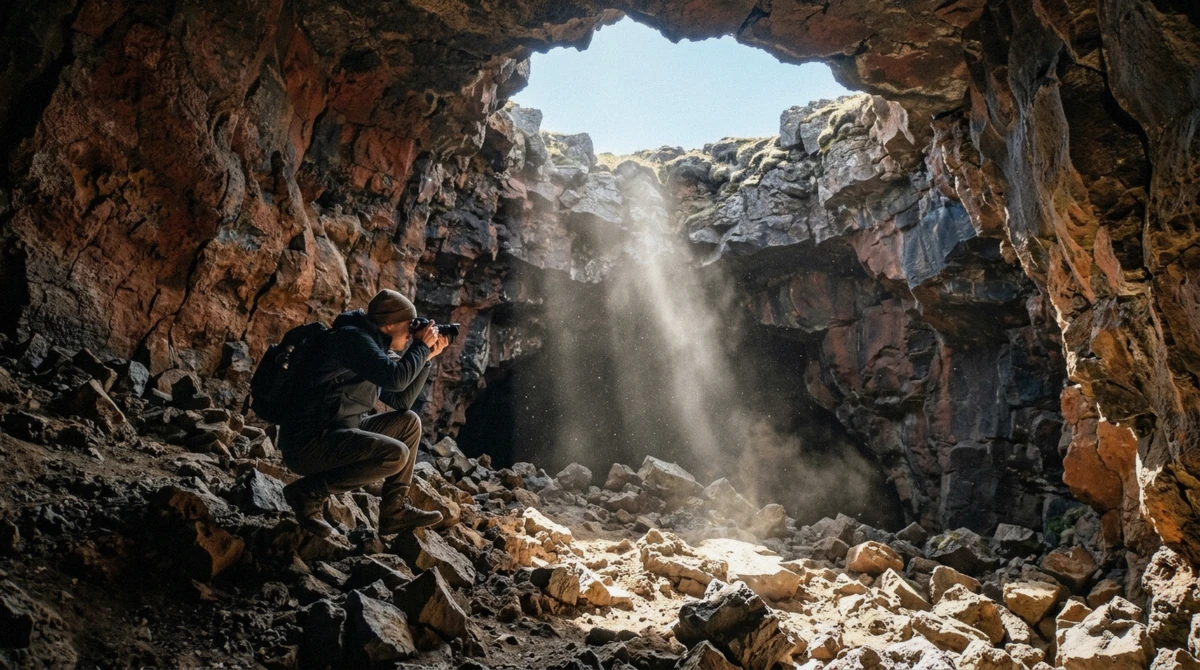
The entrance is not a doorway. It is a stretch where the roof has fallen in, leaving three holes above a slope of collapsed rock. Each hole drops a column of daylight onto the floor, and on a clear winter afternoon that light lands blue on old ice.
This is the one place in the cave where daylight and rock share a frame, which is why every group slows down here and why almost every photograph of Raufarhólshellir was taken within thirty meters of the entrance.
The roof is still coming down
Collapse is not finished business. Further along the passage there are debris piles with sharp, unweathered edges, which is what a recent fall looks like underground.
That is also the practical reason for the helmet everyone is handed at reception, and for the rule about staying on the footbridge. The safety side of a lava tunnel visit covers what the operator actually controls and what it cannot.
Colour: What Puts Red, Green and Purple in the Rock
Iron does most of the work
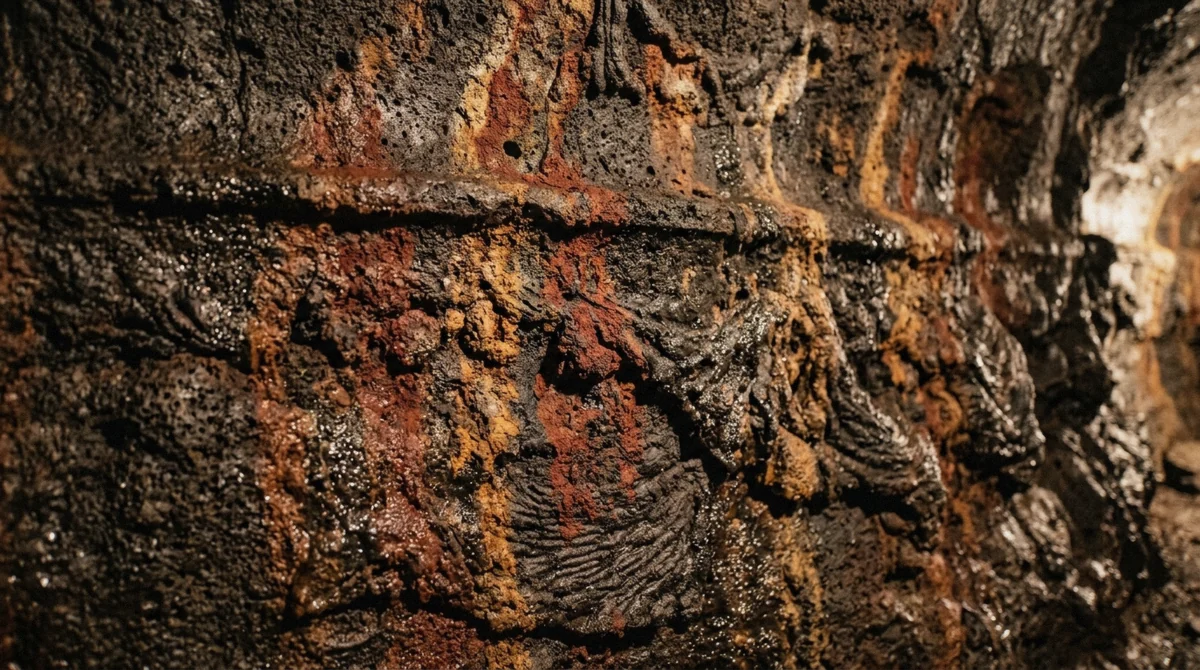
The basalt itself is dark grey. What you see on the walls is five thousand years of minerals reacting with air and dripping water. Iron gives the deep rust and red that dominates the front section. Other traces account for the greens and the purple-grey that show up where the lighting is warm and low rather than white.
Colour reads differently depending on how it is lit. On the standard tour the walkway floodlights are set low along the base of the walls, which rakes across the texture. On the adventure tour past the lighting you see the same rock in a moving circle of head-torch white, one patch at a time.
Ledges, ropes and the shape of a drained river
Run your eye along either wall and you will find horizontal shelves at two or three heights. Each one marks a level where the draining lava paused long enough to leave a mark, so the wall is a record of the flow going down.
Underfoot, beside the bridge, the floor keeps the ripples and ropes it froze with. Nothing here was carved by water or hollowed by anyone. The tube is a pipe that outlived what ran through it, and the hour on the walkway is mostly your guide reading that record out loud.
The Lights-Out Moment
Under a minute, and the thing people remember
Partway along the lit section the guide turns the floodlights off. In a passage 30 meters wide with no daylight reaching it, the dark is complete, and your eyes never adjust because there is nothing to adjust to.
It is announced first, it lasts under a minute, and it is the part of the hour that shows up most often in what visitors write afterwards. Children generally handle it better than the adults with them. If someone in your group would rather not, the guide will leave a lamp on, and asking is normal.
Ice: The One Sight With a Season
December to February, inside the entrance
Cold air and daylight both reach through the collapsed roof, which is why ice builds inside the mouth of the cave and nowhere deeper. Formations start appearing in late autumn, reach their best through December, January and February, and are gone by early summer.
Crampons come with the ticket over those months and are handed out at reception rather than requested. Deeper in, the rock holds 3 to 4°C all year, so the ice never travels far from the entrance. The month-by-month picture sets out what else changes with the calendar, most of it about the drive rather than the cave.
What the Standard Hour Does Not Show You
The lava falls, and the last two thirds of the tube
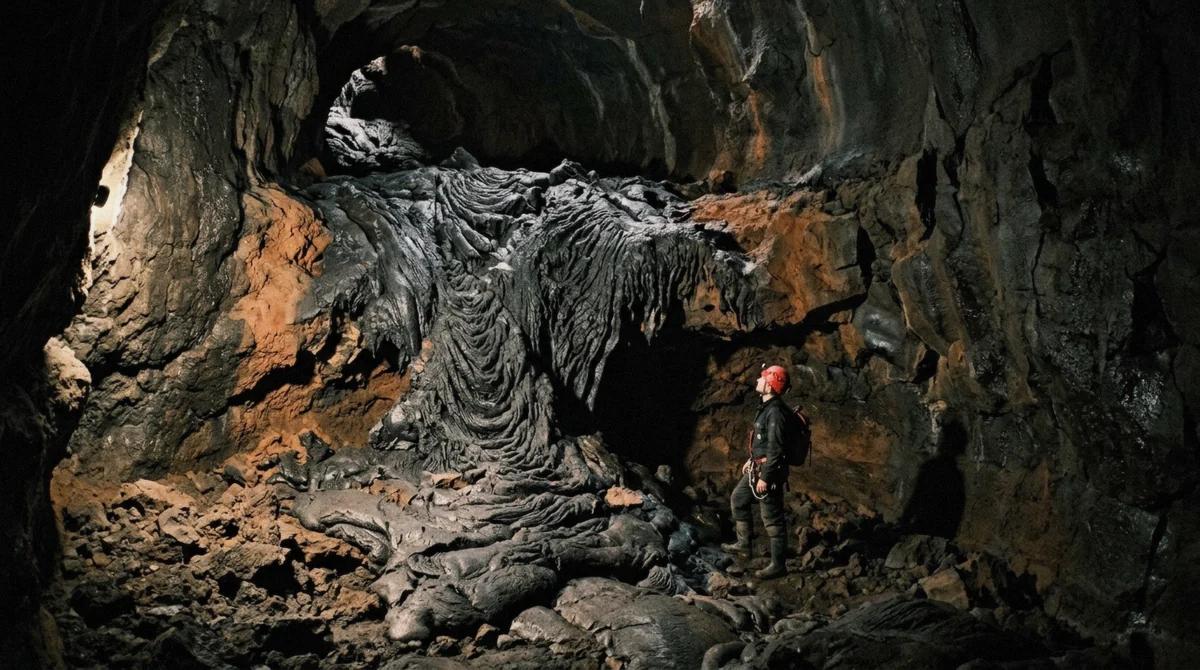
The main tunnel runs about 900 meters before it divides into three smaller branches. The lava falls sit in that final section: frozen cascades of rock formed where the flow dropped from one level to the next and then drained away. Few caves anywhere have them.
The lit footbridge does not reach that far. The only way there is the 3 to 4 hour caving tour past the lighting, which covers over 1.3 kilometres inside on head torches, in a group of no more than eight, with a minimum age of 12 and hiking boots with ankle support as a condition of joining.
Lava stalactites, which are gone
Until visitor numbers grew from the 1950s the roof carried lava straws and stalactites along whole stretches. Souvenir hunters snapped off almost all of them, and by the time more than 20,000 people a year were walking in unsupervised, the damage was done. The cave closed in late 2016, several metric tons of rubbish came out, and it reopened in mid-2017 with a walkway, lighting and guide-only access.
So the honest version is this: what you see today is the shape of the cave, not its ornament. Víðgelmir in the west still has its stalactites, because it was gated earlier.
One more thing not to expect: molten anything. The Leitahraun eruption that built this tube stopped about 5,200 years ago, and nothing here has been warm since. Iceland has active eruption sites, and this is not one of them.
| Expectation | Reality at Raufarhólshellir |
|---|---|
| Glowing or warm lava | The flow drained 5,200 years ago; the cave sits at 3 to 4°C |
| Lava stalactites on the roof | Broken off by visitors from the 1950s; almost none survive |
| Walking the full 1,360 meters | Only on the adventure tour; the lit walkway covers the front section |
| Blue ice like a glacier cave | Ice here is white and clear, forms at the entrance, and is winter only |
| A tight squeeze | Up to 30 meters wide and 10 meters to the roof through most of the route |
Which Tour Shows You Which Sights
If you want the skylights, the colour and the lights-out moment with a bridge underfoot
the standard hour does all of it, from $67.07, with a minimum age of 3 at the cave
If you specifically came for the lava falls
book the Lava Falls Adventure at $219.39; nothing else reaches them
If you are here for the winter ice
come between December and February and take any standard departure; the ice sits at the entrance where every tour passes
If you have no car
the coach and pickup options from Reykjavík reach the same cave and the same sights
What People Ask About the Inside
Can you see lava inside the lava tunnel?
No. The lava that built this tube drained out about 5,200 years ago and the rock has been cold ever since, sitting at a steady 3 to 4°C. What you see is the shape lava left: ledges where the level paused, ripples frozen in the floor, and the lava falls at the far end where the flow dropped between levels. For molten rock you need an active eruption site, which this is not.
How dark is it inside the lava tunnel?
The front section is floodlit along the base of the walls, so you walk in warm low light rather than gloom, and daylight reaches the first stretch through the three collapse skylights. Once past those, the only light is what the operator installed. At one point the guide turns it all off for under a minute, and with no daylight reaching that depth the darkness is total.
What colours are the walls of Raufarhólshellir?
Rust and deep red from iron, with green and purple-grey where other minerals have reacted with air and dripping water over five thousand years. The colour reads strongest under the warm walkway lighting in the front section, and differently again on the adventure tour, where a head torch picks out one patch at a time.
Are there stalactites in the lava tunnel?
Not any more. Lava straws and stalactites covered stretches of the roof until visitor traffic grew from the 1950s, and souvenir hunters broke off almost all of them before the cave was gated. That damage is the reason access is guided only today. Víðgelmir, in west Iceland, still has its lava stalactites intact.
What are the lava falls and can I see them?
They are frozen cascades of rock at the source end of the tube, where the flow dropped from one level to another and then drained away, and they sit past the end of the lighting. The standard hour does not reach them. The Lava Falls Adventure tour covers over 1.3 kilometres inside on head torches, takes 3 to 4 hours and is 12 and over.
Is there ice inside the cave in summer?
No. Ice forms inside the entrance where cold air and daylight reach through the collapsed roof, builds from late autumn, peaks from December to February and melts back through spring. By June the entrance is bare rock. The temperature deeper in never changes, so the rest of what you see looks the same in July as in January.
How wide is the tunnel inside?
Up to 30 meters wide with headroom up to 10 meters through most of the route, which is why visitors who describe themselves as claustrophobic usually get through the standard tour without trouble. Where Route 39 crosses overhead the tube narrows to roughly 15 meters across, and cars pass above without a sound reaching you.
The cave rewards a slow eye rather than a long walk. Most of what makes Raufarhólshellir worth the drive sits in the first few hundred meters, and an hour is enough to take it in properly if you stop looking for the next thing. If you want the sights the walkway cannot reach, the adventure tour is the only ticket that goes there.